
Orthodontic Before and After Dubai: Class II Correction with Twin Block & Braces (14‑Year‑Old Female)
Transformative Results: Orthodontic Before and After Dubai Insights
This patient (14‑year‑old female in Dubai) came to our clinic because her upper front teeth and front teeth looked teeth protruding, her upper teeth and lower front teeth were irregular, and her chin looked recessed. After careful diagnosis, we designed an orthodontic treatment and treatment plan that corrects Class II malocclusion by using functional appliances first and traditional braces second. The twin block phase improved jaw position; the braces phase finished the teeth detail and the bite. Braces work by applying gentle pressure to guide the teeth into proper bite alignment and achieve straight teeth.
The end result is a confident new smile, improved facial aesthetics, enhanced facial profile, greater self esteem, and stable function that supports oral health.
First Consultation, First Visit & Cephalometric Analysis
At the first consultation and first visit, our orthodontist completed records, photos, and cephalometric analysis. We explained the treatment plan to the patient and the patient’s parents, addressing the concerns and involvement of the patient's parents in the decision-making process, and including goals, treatment time, and hygiene instructions during treatment.
Diagnosis & Treatment plan Development
-
Skeletal: skeletal Class II pattern, Class II Division 1 due to reduced mandibular growth (not excessive maxillary growth).
-
Dental: increased overjet (~6 mm), deep overbite, bilateral scissors bite, crowding of upper teeth and lower front teeth; no severe crowding requiring extractions. During diagnosis, bite issues such as malpositioned lower molars and a narrow maxillary arch were identified.
-
Soft tissue: convex profile with a retrusive chin and strain on the lower lip.
-
Class II malocclusion is exactly reverse to the Class III malocclusions.
Why This Treatment Plan Works
Our objective was to correct Class II malocclusion, align upper front teeth and lower front teeth, normalize overbite, and improve the profile. Individualized treatment plans were developed for each patient to address their specific dental condition, age, and social factors. Early intervention with functional appliances was chosen as a cost effective strategy to prevent the need for more extensive orthodontic treatments in the future. We outlined two coordinated phases of treatment:
Phase 1 — Functional Orthopedics (6 months)
-
Twin block appliance: A custom made orthodontic device designed to improve the relationship between the upper and lower jaws by posturing the lower jaw forward.
-
The twin block appliance works by encouraging the lower jaw to move forward, helping to achieve better harmony between the upper and lower dental arches.
-
These functional appliances can stimulate mandibular growth (growth‑friendly guidance) and reduce teeth protruding in the top teeth.
-
Success depends on patient cooperation, daily wear, and excellent oral hygiene to protect overall oral health and prevent gum disease during treatment.
-
This phase shortened later treatment time and reduced risk of worsening deep overbite.
Phase 2 — Comprehensive Fixed Appliances (≈16 months)
-
Traditional braces with fixed appliances and metal brackets were used to align the teeth, coordinate arches, and refine the bite. Small tooth-colored attachments or brackets were precisely placed on each tooth to guide them into their correct positions.
-
We used Class II elastics to guide the molar relationship and settle the occlusion.
-
With braces, the teeth were brought into correct positions predictably.
-
Retention: bonded lower retainer and an upper Essix as needed to protect long term dental health.
Alternatives discussed: discreet treatment with clear aligners / removable aligners was reviewed, but aligners do not advance the jaw like Twin Block appliances. Surgical correction or jaw surgery can be required in severe Class II malocclusions, but this patient improved without surgery. Premolar extractions were not necessary.
Pre‑ vs Post‑Treatment Gallery
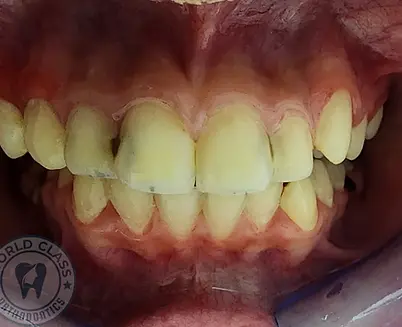
Pre‑treatment Fontal view
-
Widened upper arch
-
Scissors bite on both sies
-
overjet 5-6mm
-
Upper mid line shift

Post‑treatment Fontal view
-
Midline aligned
-
All scissors' bites corrected
-
Lower arch well aligned with upper arch
-
Right and left arches are balanced

Pre - Treatment Right occlusal view
-
End on Canine Relationship
-
End on Molar Relationship
-
Scissors bite

Post - Treatment Right occlusal view
-
Class I Canine Relationship
-
Class I Molar Relationship
-
Ideal occlusal contacts

Pre - Treatment left occlusal view
-
End on canine
-
End on molar
-
Scissors bite

Post - Treatment left occlusal view
-
Cross bites corrected
-
Class I Canine Relationship
-
Class I Molar Relationship
-
Ideal occlusal contacts

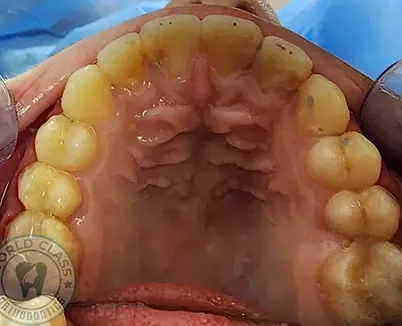
Pre‑treatment maxillary arch
-
2nd premolars are labially placed
-
Crowding in the anteriors
Post‑treatment maxillary arch
-
Balanced upper arch
-
Corrected upper midline
-
Achieved ideal U-Shaped arch form

Pre‑treatment mandibular arch
-
Mild Crowding

Post‑treatment mandibular arch
-
Corrected crowding
-
Well aligned lower teeth
-
Achieved ideal arch form
-
Precisely Placed lower fixed retainer
Results (Before → After)
-
Overjet & Overbite: overjet reduced from ~6 mm to ideal; deep overbite normalized. Addressing the overbite protects the teeth and gums and supports overall oral health.
-
Bite: from Class II malocclusions to Class I molar relationship and stable posterior contacts; bilateral scissors bite corrected.
-
Alignment: upper front teeth, lower front teeth, and adjacent teeth aligned; arch forms coordinated.
-
Profile: improved chin projection and balanced profile; better harmony between lips and teeth.
-
Smile: broader, brighter smile with improved incisor display—an authentic new smile the patient and family are proud of.
-
Treatment time: ~22 months total (6 + 16), with regular reviews to protect oral health and reinforce treatment goals.
Understanding Overjet & Overbite (for parents)
Families often mix up terms. Overjet is how far the upper teeth sit ahead of the lower teeth; overbite describes vertical overlap of the teeth. In many Class II malocclusions, a large overjet co‑exists with a deep overbite. Early control of the overbite during treatment prevents wear and supports long‑term stability.
Why Twin Block Appliances in Teens?
In growing patients, twin block appliances (a type of functional appliances) are custom made to guide the lower jaw and improve the relationship between jaws before braces. This treatment helps the teeth and jaws fit better, reduces the appearance of teeth protruding in the upper front teeth, and often reduces later treatment time. For many Class II malocclusions, it offers predictable results without surgical correction.
Retention Plan
-
Upper retainer worn full-time for 6 months, then nights only
-
Patient educated on hygiene, retainer use, and follow-up schedule
FAQs
-
Can braces alone fix this type of case?
Braces are excellent for moving teeth, but in adolescents with a clear skeletal Class II pattern, we often need twin block therapy first to harness remaining growth, then finish treatment with braces.
-
Is early treatment necessary for most children?
Not always. However, early intervention during active dental development can guide the jaws and prevent a worsening deep overbite. We discuss options at the first consultation.
-
Will aligners work if we want discreet treatment?
Clear aligners are great for aligning teeth, but they don’t advance the jaw the way Twin Block appliances do. For this patient, the two‑phase treatment provided optimal results without surgery.
-
How do you protect oral health during treatment?
We coach oral hygiene at every visit to limit plaque around teeth and appliances and reduce risk of gum disease. Good care supports long term dental health after treatment.
Case Treated by:
Dr. Srinivasa Rao Bogavilli, MDS (Orthodontics)
Specialist Orthodontist • Teen & complex cases • Since 2010 • 2,000+ cases
WhatsApp/Call: +971 58 596 3637
Book: Free consultation at Dubai (Deira)
(Also treating families in Sharjah — Al Majaz.